Annual Reports
Herbalife Ltd.'s annual reports contain management's most considered account of the business. These are the sections, passages and visual pages worth opening in the originals preserved in Sources.
Herbalife Ltd. — FY2025 Annual Report (Form 10-K) — FY2025
The latest 10-K, and the fullest account of a business where the customer base and the salesforce are the same 6.4 million people. · Open the full document →
Item 1. Business — p. 7 · Read the full section →
The self-description management stands behind: a direct-selling nutrition company whose customers and salesforce are the same people.
Opening description of the company and the direct-selling model.
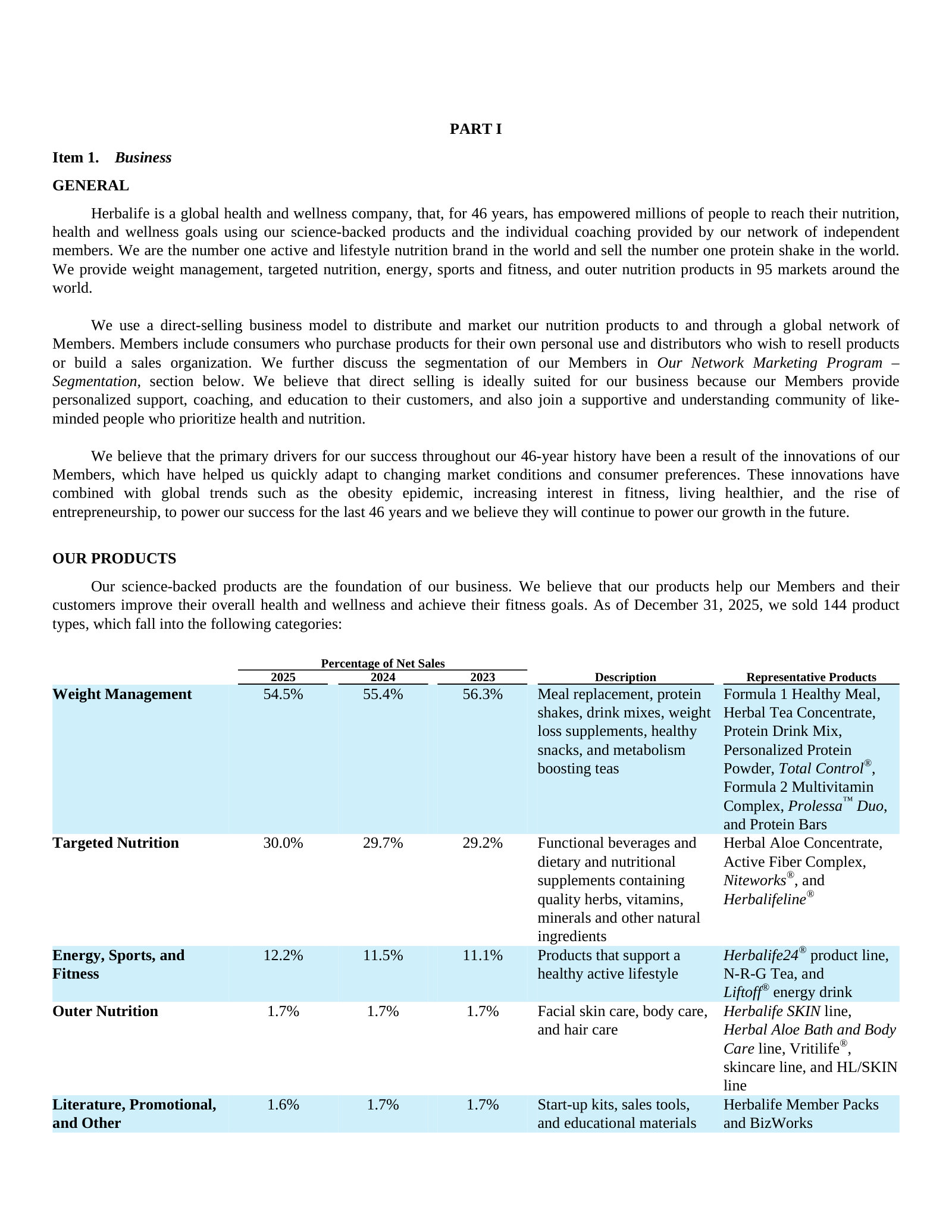
Herbalife is a global health and wellness company, that, for 46 years, has empowered millions of people to reach their nutrition, health and wellness goals using our science-backed products and the individual coaching provided by our network of independent members. We are the number one active and lifestyle nutrition brand in the world and sell the number one protein shake in the world. We provide weight management, targeted nutrition, energy, sports and fitness, and outer nutrition products in 95 markets around the world.
We use a direct-selling business model to distribute and market our nutrition products to and through a global network of Members. Members include consumers who purchase products for their own personal use and distributors who wish to resell products or build a sales organization.
p. 7 · Read in context →
COMPETITION — p. 9 · Read the full section →
Names the competitor set on both sides — retail nutrition brands and rival direct sellers — and explains the daily-consumption model.
How management says Nutrition Clubs and daily consumption differentiate the business.
We believe we have differentiated ourselves from our competitors through the innovation of our Members and their focus on “daily consumption” of our products. For example, Members in Mexico developed a sales strategy that became known as “Nutrition Clubs,” which are brick and mortar locations where Members sell prepared, single-serving versions of our products in a setting that also provides a socially supportive community that we believe helps customers achieve their health and wellness goals. Rather than buying a 30-day supply of products, these independently owned and operated businesses allow consumers to purchase and consume our products each day.
p. 9 · Read in context →
OUR NETWORK MARKETING PROGRAM — p. 11 · Read the full section →
Where the revenue model is set out: who the 6.4 million Members are and how much of the retail price is paid away to them.
Member segmentation and counts as of December 31, 2025.
In many of our markets, including our largest markets of United States, India and Mexico, we have segmented our Member base into two categories: “preferred members” – who are consumers who wish to purchase product for their own household use, and “distributors” – who are Members who also wish to resell products or build a sales organization. […] As of December 31, 2025, we had approximately 6.4 million total Members, including 3.1 million preferred members and 2.3 million distributors in the markets where we have established these two categories and 0.2 million sales representatives and independent service providers in China.
p. 11 · Read in context →
Business in China — p. 14 · Read the full section →
China is a separate reporting segment because the model is different — service providers and licences, not multi-level marketing.
Why the China business is structured and reported separately.
Our business model in China includes unique features as compared to our traditional business model in order to ensure compliance with Chinese regulations. As a result, our business model in China differs from that used in other markets. Members in China are categorized differently than those in other markets. In China, we sell our products to and through independent service providers and sales representatives to customers and preferred customers, as well as through Company-operated retail platforms when necessary.
In China, while multi-level marketing is not permitted, direct selling is permitted. Chinese citizens who apply and become Members are referred to as sales representatives.
p. 14 · Read in context →
Our failure to establish and maintain Member and sales leader relationships could negatively impact sales of our products and materially harm our business, financial condition, and operating results. — p. 33 · Read the full section →
The structural risk in the model: all sales run through independents who face no switching cost and turn over heavily.
Dependence on independent Members and the low cost of leaving.
We distribute our products exclusively to and through our independent Members, and we depend on them directly for substantially all of our sales. To increase our revenue, we must increase the number and productivity of our Members. […] In addition, our Member organization has a high turnover rate, which is common in the direct-selling industry, in part because our Members, including our sales leaders, may easily enter and exit our network marketing program without facing a significant investment or loss of capital. For example, the upfront financial cost to become a Member is low, we do not have time or exclusivity requirements, we do not charge for any required training, and, in substantially all jurisdictions, we maintain a buyback program.
p. 33 · Read in context →
Our share price may be adversely affected by third parties who raise allegations about our Company. — p. 46 · Read the full section →
Herbalife names its own history here — the 2012 short campaign is a disclosed, recurring risk rather than a generic market caveat.
The company’s own account of the 2012 short-seller campaign.
Short sellers and others who raise allegations regarding our business activities, some of whom are positioned to profit if our share price declines, can negatively affect our share price. For example, in late 2012, a hedge fund manager publicly raised allegations regarding the legality of our network marketing program, our product safety, our accounting practices, and other matters, and announced that his fund had taken a significant short position regarding our common shares, leading to intense public scrutiny and significant share price volatility. Following this public announcement, our share price dropped significantly.
p. 46 · Read in context →
We are subject to the Consent Order with the FTC, the effects of which, or any failure to comply therewith, could materially harm our business, financial condition, and operating results. — p. 50 · Read the full section →
The 2016 FTC settlement is a live constraint with a numeric trigger that can cap what U.S. distributors are paid.
The 80% test and the 41.75% cap on U.S. distributor compensation.
In addition, the Consent Order provides that if the total eligible U.S. sales on which compensation may be paid falls below 80% of the Company’s total U.S. sales for a given year, compensation payable to distributors on eligible U.S. sales will be capped at 41.75% of the Net Rewardable Sales amount as defined in the Consent Order. Because our business is dependent on our Members, our business operations and net sales could be adversely affected if U.S. distributor compensation is restricted or if any meaningful number of Members are dissatisfied, choose to reduce activity levels, or leave our business altogether.
p. 52 · Read in context →
Presentation — p. 81 · Read the full section →
The MD&A key to reading the P&L: what net sales are net of, and why selling expenses are Member pay rather than marketing.
Definition of selling expenses — Member compensation, the largest operating cost.
Our “selling expenses” primarily consists of certain compensation to our Members. Our sales leader Members may also earn sales commissions and bonuses, which are also considered Member compensation. Globally, excluding China, while certain Members may profit from their activities by reselling our products for amounts greater than the prices they pay us, Members that develop, retain, and manage other Members may earn Member compensation for those activities, which is paid based on retail sales volume of certain other Members who are sponsored directly or indirectly by the Member. This Member compensation is a significant operating expense.
p. 82 · Read in context →
Financial Results for the Year Ended December 31, 2025 Compared to the Year Ended December 31, 2024 — p. 85 · Read the full section →
Management’s own bridge for 2025: growth came from price, not volume, and earnings fell on tax despite better operations.
The 2025 net sales bridge: price up 3.2%, currency down 1.6%, volume down 0.5%.
Net sales were $5,037.5 million for the year ended December 31, 2025. Net sales increased $44.4 million, or 0.9%, for the year ended December 31, 2025 as compared to the same period in 2024. In local currency, net sales increased 2.5% for the year ended December 31, 2025 as compared to the same period in 2024. The 0.9% increase in net sales for the year ended December 31, 2025 was primarily driven by a 3.2% favorable impact of price increases, partially offset by a 1.6% unfavorable impact of fluctuations in foreign currency exchange rates and a 0.5% decrease in sales volume.
p. 85 · Read in context →
The 2025 net income bridge, led by $132.2 million higher income taxes.
Net income attributable to Herbalife was $228.3 million, or $2.20 per diluted share, for the year ended December 31, 2025. Net income attributable to Herbalife decreased $26.0 million, or 10.2%, for the year ended December 31, 2025 as compared to the same period in 2024. The decrease in net income attributable to Herbalife for the year ended December 31, 2025 was mainly due to $132.2 million higher income taxes; partially offset by $61.3 million lower general and administrative expenses driven by lower labor and benefits costs (see General and Administrative Expenses below for further discussion), $34.1 million higher gross profit driven by higher net sales, and $10.5 million loss on extinguishment of debt in 2024 related to the April 2024 debt refinancing transactions (see Liquidity and Capital Resources below for further discussion).
p. 87 · Read in context →
Herbalife Nutrition Ltd. — FY2021 Annual Report (Form 10-K) — FY2021
Included for one section: the Volume Point disclosure management has since retired, at the 2021 peak the company has not revisited. · Open the full document →
Volume Points by Geographic Region — p. 53 · Read the full section →
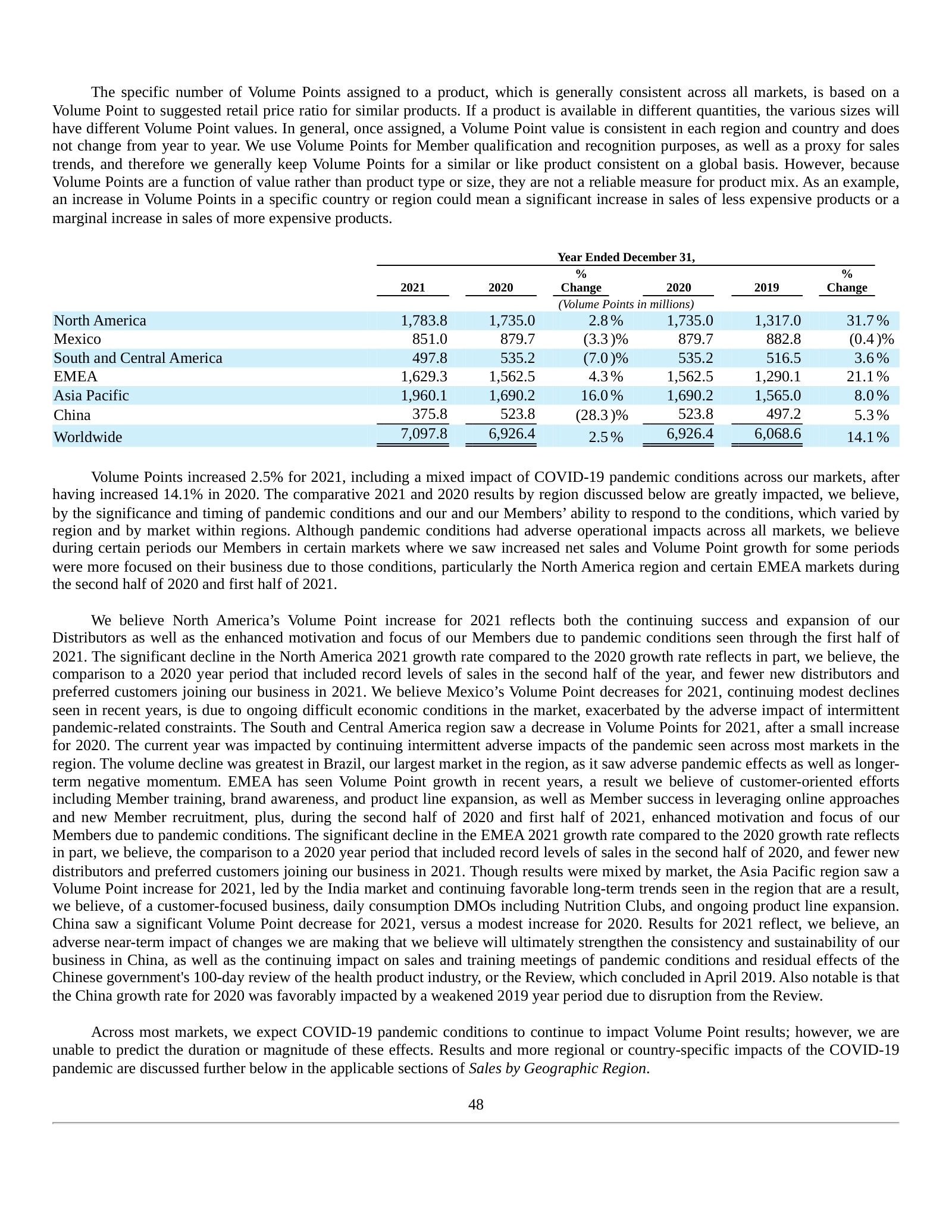
Volume Points were the volume KPI through 2021; management stopped disclosing them by region, so this is the last clear view of unit trends.
How management defined Volume Points and why it used them as the volume proxy.
A key non-financial measure we focus on is Volume Points on a Royalty Basis, or Volume Points, which is essentially our weighted-average measure of product sales volume. Volume Points, which are unaffected by exchange rates or price changes, are used by management as a proxy for sales trends because in general, excluding the impact of price changes, an increase in Volume Points in a particular geographic region or country indicates an increase in our local currency net sales while a decrease in Volume Points in a particular geographic region or country indicates a decrease in our local currency net sales.
p. 53 · Read in context →
More annual reports
Herbalife Ltd. — FY2024 Annual Report (Form 10-K) — FY2024 · 214 pages · The last edition to disclose Volume Points by region, and the year of the corporate reorganization that drove a large deferred tax benefit. · Open →
Herbalife Ltd. — FY2023 Annual Report (Form 10-K) — FY2023 · 216 pages · First 10-K after the registrant name reverted to Herbalife Ltd., and the last year North America sales leaders stood near 70,000. · Open →
Herbalife Nutrition Ltd. — FY2022 Annual Report (Form 10-K) — FY2022 · 168 pages · Filed under the Herbalife Nutrition name, with the old royalty-override P&L presentation still in place. · Open →